THIS `Big Three’ is ready for action

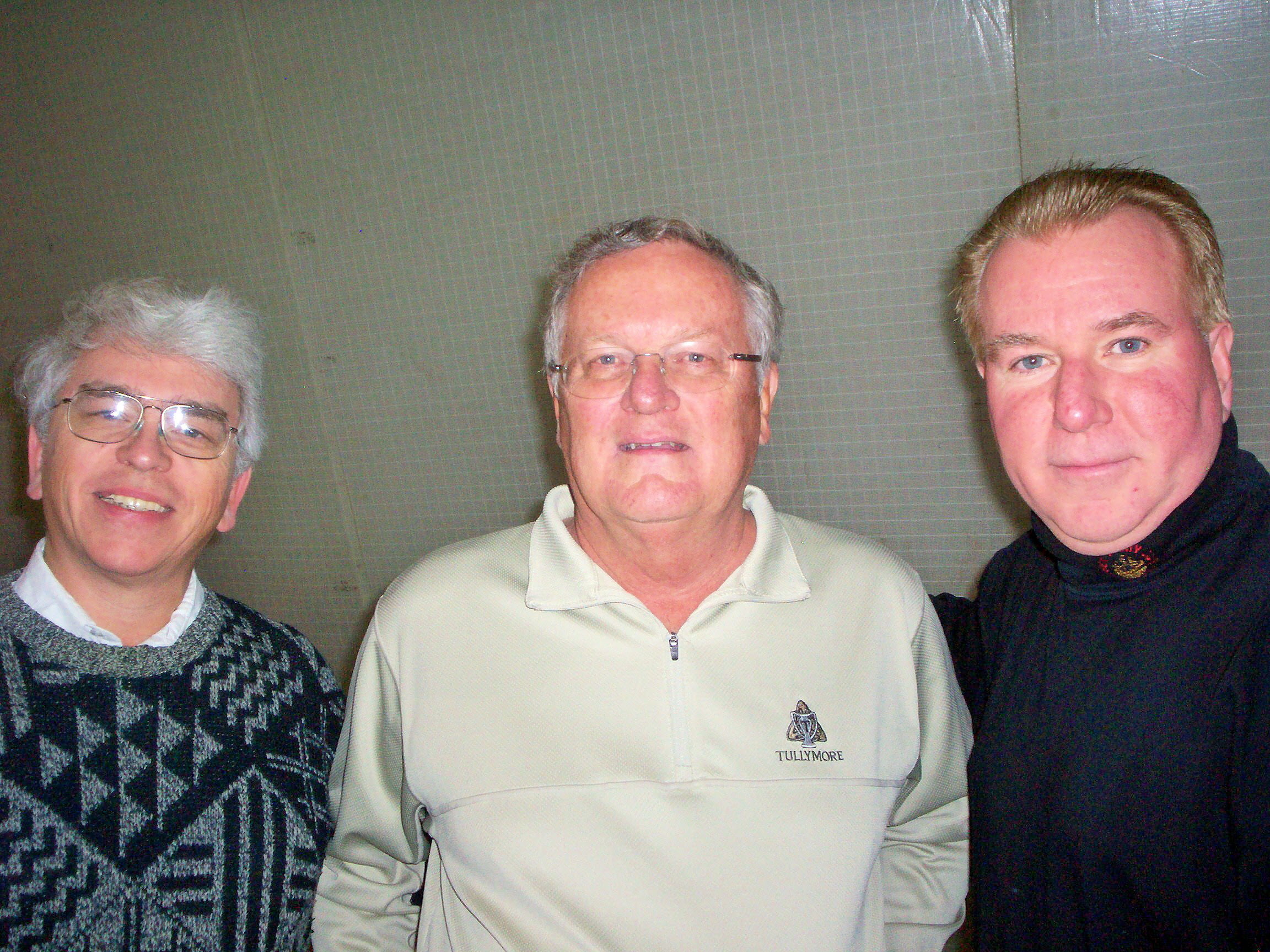
This “Big Three” may not be anything like Arnold Palmer, Jack Nicklaus and Gary Player, but we feel we can make a positive impact on golf — especially in the Chicago area.

From left, Tim Cronin, Len Ziehm, Rory Spears

We are three golf reporters with a combined 102 years of experience covering the sport we love. We’re kicking off 2012 by announcing an affiliation agreement in which we’ll spotlight the lead stories on each other’s websites. We see this as a means of staying ahead of the rapidly changing media changes within the golf industry.

While there will inevitably some overlap in the subjects we cover, our websites are each a bit different. Rory Spears (www.golfersongolf.com), the best golfer in our trio, is a rater for GolfWeek magazine. He’s worked in a variety of positions during his 27 years in the golf industry. In addition to writing The Gog Blog, he is co-host of Golfers on Golf which is in its 10 season as Chicago’s longest-running golf radio show.

Tim Cronin, for 33 years the golf writer and columnist for the Daily Southtown/Star, has established himself as the premier Chicago golf historian. He’s written four books on the histories of Chicago clubs. He’ll be offering his unique perspectives on the golf news of the day on his website, www.illinoisgolfer.net.

My lenziehmongolf.com will continue to focus on golf travel destinations and tournament reports. If one of us doesn’t provide what you’re looking for, chances are good that one of the other two will.

The affiliations with Rory and Tim means that Len Ziehm on Golf is now connected with three other websites. We earlier reached agreement with Cheryl Justak’s “Golf Now! Chicago,’’ the premier travel destination guide. My travel stories will run on her www.golfnowchicago.com.

JUST MY OPINION: Luke Donald has topped them all

On Sunday Luke Donald finished third in the Dubai World Championship and became the first golfer to win money titles on both the U.S. and European PIA Tours while holding membership in both.

This is something for the history books, and the feat hasn’t gotten the attention it should have from the sports media both in and away from Chicago. When you factor in what went on both on and off the course I believe Donald’s 2011 topped the accomplishments of all athletes, in all sports.

First he rises to No. 1 in the world, then pads his lead. When Webb Simpson threatened to claim the money title on the PGA Tour Donald added a late-season tournament and won it. When Rory McIlroy had a chance (however slim) to get the European money title Donald responded with a solid third-place showing with all that historical significance on the line.

He may still be without a major championship, but Luke was consistently good and at his best when the going was toughest.

All that success on the course came with two life-changing developments off the course — the birth of a daughter and the death of his father. It wasn’t so long ago, either, that Donald made a difficult decision — parting company with his brother as his caddie — that also factored into his extraordinary 2011 season.

Personally I feel an attachment to the Donald saga because I’ve seen a lot of it develop from up close. He was the leader of a Northwestern golf team that brought the Wildcats national prominence. I’ll also recall his victory in the Chicago Open at Beverly Country Club in the midst of the 9/11 tragedy. Luke was just an amateur playing against regional pros then, and I’m not sure the event should even have been held, given the circumstances facing the entire country at the time, but Donald emerged the champion and gave an early hint about where his golf career was headed.

Not long after that I had a lengthy sitdown with Luke and his brother in their Evanston apartment for a golf magazine profile on golfers with promise. Luke certainly fulfilled his, and remained an extraordinarily strong supporter of the NU program while doing it.

In the near future Donald will like learn if he gets his wish from the Western Golf Assn. He has made it known that he’d like the BMW Championship be moved to Conway Farms, his home course in Chicago, in 2013. I’m not so sure he’ll get his wish on that one. The WGA has been mum on that subject, though Conway would make a viable venue for that tournament.

Tourney sites are intriguing for CDGA, WGA

The Chicago District Golf Assn. and Western Golf Assn. have made major announcements in their tournament sites just a few days apart.
In announcing its tournament slate for 2012 the CDGA revealed that Cantigny, the 27-hole public layout in Wheaton, will host the concluding four-day match play portion of the CDGA Amateur. That’s significant because the finals haven’t been held on a public course since 1991. Last year the prestigious tourney wrapped up at Medinah, with the final on that club’s No. 3 course that will host the 2012 Ryder Cup matches.
Kokopelli, in Marion, will host the CDGA’s biggest tourney of the season — the 82nd Illinois State Amateur. That site marks a milestone as well, since Kokopelli will be the southern-most course to ever host the tourney. It’s about 25 miles further south than Rend Lake, in Whittington — the site of the 1998 championship.
“This is only the second time ever that the Illinois State Amateur has ventured to the southern portion of the state, and we couldn’t have found a better course,’’ said Nick Scillia, the CDGA manager of competitions and rules.
Rend Lake was the host venue when current PGA Tour player D.A. Points won the second of his three Illinois Am titles.
The WGA made a schedule switch for the 2013 season, dropping Olympia Fields as the site of the Western Amateur and moving the event to The Alotian Club in Arkansas.
After ending a 28-year run at Point O’Woods in Benton Harbor, MIch., the WGA had planned to base the tourney in the Chicago area and the first three tourneys in that run — Conway Farms in 2009, Skokie in 2010 and North Shore in 2011 — were successful. The year’s Western Am will be at Exmoor, a tradition-rich private club in Highland Park.
The Chicago run, though, will end with the move to The Alotian Club, a Tom Fazio design that is owned by Augusta National member Warren Stephens. Alotian Club has been well-received since its opening in 2004 and its two Evans Scholars, Joe and Kevin Evans, are Northwestern students.
The Chicago run is scheduled to resume in 2014 at Beverly and is targeted for Rich Harvest Farms in 2015 and Knollwood in 2016.
Olympia Fields has been Chicago’s busiest tournament site in recent years, the highlight coming when it hosted the 2003 U.S. Open. Olympia also hosted the U.S. Girls Junior in 2011 and is gearing up for the U.S. Amateur in 2015, which will highlight the club’s centennial celebration.
Vince Pellegrino, tournament director for the WGA, said the decision to end the Chicago run came after the invitation from The Alotian Club.
“We discussed a possible change with Olympia Fields officials, and we then made a joint decision to move the championship,’’ said Pellegrino. “We appreciate the club’s flexibility in agreeing to the move, which will allow us to broaden our reach and mission to other markets, particularly to a venue that also has been very supportive of our Evans Scholars program.’’
With the WGA still without a site for its biggest event, the BMW Championship, in 2013, there was speculation that Olympia Fields might host that event, but that isn’t expected to happen now. The WGA is focusing on courses in the northern suburbs for that event, though a return to Cog Hill in Lemont is still a possibility.

Introducing wire-grass at Pinehurst No. 2

PINEHURST, N.C. — My frequent golf travels have led me to introduce you to a term you’re certain to hear more about in the next few months and years. It’s called wire-grass, the key ingredient in the recent renovation of North Carolina’s Pinehurst No. 2 — one of the world’s most famous courses, as well as one of my all-time favorites.

Pinehurst is certainly no secret. It’s been welcoming guests since 1895 and is America’s largest golf resort with its eight courses. The insertion of wire-grass on its famed No. 2 course, though, is something new and significant. While the topic of wire-grass hasn’t been talked about much yet, it will be. The U.S. Golf Assn., in an unprecedented move, has scheduled for the U.S. Open and U.S. Women’s Open at Pinehurst in 2014. By then wire-grass will be a well-known golf term.

Wire-grass doesn’t look all that great, but that’s what Donald Ross — the famed architect of the early 1900s — worked with in creating his layout at Pinehurst No. 2.

According to Don Sweeting, one of PInehurst’s vice presidents and my recent tour guide over the course, wire-grass is “a clump of grass that grows to four-six inches tall and has plumes on it and is very wispy….I provides an obstacle to golfers to play through it — but it’s very easy to find your ball.’’

Sweeting tells me that wire-grass is very indigenous to the sandhills of North Carolina. The fact that it was allowed to grow at Pinehurst No. 2 certainly changed the look of the course that hosted U.S. Opens in 1999 and 2005. I covered both. For those events the rough was bermuda, just like the fairways, only longer.

Pinehurst had a pristine look then. Now it’s more traditional and the rough is more unpredictable for golfers. Maybe some golfers won’t like the new look, but I did because Ross is one of the all-time great architects whose work has withstood the tests of time. He lived off the No. 3 hole at Pinehurst No. 2 before his death in 1948.

“We felt we had moved away from the Donald Ross era,’’ said Sweeting. “Pinehurst is known for its history, and you don’t want to go away from your history; you want to preserve it. We’ve normally done an excellent job of that, but we got away from it in the 1970s and 1980s. The golf world was going to the pristine and perfect look then, but that wasn’t what Donald Ross was all about.’’

Ryder Cup enthusiasm builds

Sure, Medinah’s week to host the 39th Ryder Cup is still a year away. Still, the task of getting ready for the biggest team event in golf is a major undertaking.
Michael Belot, the tournament director, and five staffers have been working feverishly from Medinah and report making great progress. Belot should know, becuase he is in his 10th year working for the PGA of America and was the tournament director for the 2006 PGA Championship, which was also held at Medinah, as well as the 2009 PGA at Hazeltine in Minnesota.
The Ryder Cup, though, is a different animal.
“With all the rich history that the club has, this will stand out as Medinah’s crowned jewel,’’ Belot said. “It’ll be the biggest golf event ever in Illinois.’’
Medinah hosted U.S. Opens in 1949, 1975 and 1990, PGA Championships in 1999 and 2006 and the U.S. Senior Open in 1988. Those were big events — but the battle between the U.S. and Europe on Sept. 25-30, 2012, will be notably bigger.
“Chicago is known for big events,’’ said Belot, “and this market has embraced this Ryder Cup.’’
Here is some evidence of that:
As of this printing 60 corporate hospitality chalets, costing between $235,00 and $500,000, have been sold.
“We started out offering 59 chalets, so now we’re adding chalets that we hadn’t expected to add,’’ said Belot. “We’ve added a village we had not expected to add, and we’re exploring whether to add more.’’
While that sales process is going on Belot’s staffers have been bidding out what’s needed for the opening and closing ceremonies as well as the Ryder Cup gala, which will be held the Wednesday of tournament week.
Public ticket sales to the competition will begin at 8 a.m. on June 20 — the day after the U.S. Open concludes at Congressional. That’s when people can sign up for the random draw for tickets. That’ signup will continue for about two months. Crowds will be limited to about 25,000 per day. (For more details on the ticket situation check out the rydercup.com website).
Tickets will range from $35 for a daily ticket to $680 for the premium weekly offering. All youngsters 17 and under will get complimentary admission on the three practice days if they’re accompanied by a ticketed adult. Such a practice has never been done at a Ryder Cup.
About 3,500 volunteers will be needed to stage the competition, and Belot said about 5,000 have already called in to request assignments. Medinah members will have first crack at the voluntary positions, then what remains will be offered to the general public on July 11. A volunteer package costs $235, which includes a tournament badge, uniforms, meals, programs and other perks.
Already there’s been some notable preliminary events, and more will be forthcoming as the next Ryder Cup closes in. Biggest so far was the press conference announcing Davis Love III as U.S. captain on Jan. 20. Love and European captain Jose Maria Olazabal will have a joint press event at Medinah on Sept. 26, as the one-year to Ryder week countdown begins.
As for Medinah members, they were already treated to the unveiling of a Leroy Neiman painting that the famed artist created to commemorate this Ryder Cup.
Meanwhile, Medinah’s No. 3 course that will be used for the matches will continue to mature after its reopening last year. As part of a major renovation famed architect Rees Jones designed a new 15th hole, adding a pond to create a driveable par-4. That was the major change, but all of the tees and greens were regrassed to conform to U.S. Golf Association specifications. There won’t be any big events on No. 3 this summer to allow the latest renovation to settle in.
“This will be the first time in a long time that no bulldozers are on the golf course, and that’s a good thing,’’ said Don Larson, Medinah’s chairman for the Ryder Cup.
Larson has one concern that he wants to pass on.
“Beware of pirate hospitality groups that are billing themselves as official,’’ said Larson. “Already people are on eBay selling tickets.’’

Blakeman is back in U.S. Open

Just qualifying for the U.S. Open is a big deal. This year 8,300 tried, and only 156 will tee off in the first round on Thursday at Congressional Country Club in Bethesda, Md.
One of them will be Bennett Blakeman, who isn’t exactly a household name in golf circles yet — but he is a U.S. Open veteran. He made it to last year’s U.S. Open as well but finished dead last among those 156 who qualified to play at Pebble Beach in California.
On both occasions Blakeman, a former Illinois Wesleyan golfer who lives in Burr Ridge, survived the rugged local and sectional eliminations to get to the big show. This time, though, it’ll be a wiser and more experienced Blakeman who tees off Congressional’s No. 10 tee at 2:41 p.m.
Last year Blakeman was an amateur finishing up coursework at Loyola University for a master’s degree in business and health care management. For this U.S. Open Blakeman, 24, is a golf professional with a new caddie, a new swing instructor and more preparation time. After finishing up at Loyola he moved into his family’s vacation home in Scottsdale, Ariz., and spent the winter playing on the Gateway Tour, a long-time proving ground for PGA Tour hopefuls.
“The Gateway left a lot to be desired,’’ said Blakeman, “but I also made a rather significant swing change and wanted to make a strong effort to keep things in perspective. It’s all part of a process.’’
Dale Abraham became his swing coach in Arizona. Ryan Dorner, a former teammate at Illinois Wesleyan, will become his caddie.
“I’ll also have him for (PGA) Tour School and hopefully beyond,’’ said Blakeman, whose brother Brenten was on his bag at Pebble Beach and his father Brad handled that job during this year’s Open qualifiers.
Blakeman arrived at Congressional on Sunday, a day earlier than he checked in at Pebble Beach.
“I felt I was a little late last year. This year I wanted to take care of all the administrative stuff right away,’’ said Blakeman. “Last year I got a good taste of (the Open). Now I’ll know a lot more in terms of the circus atmosphere surrounding it.’’
In addition to PGA Tour regulars Kevin Streelman, Mark Wilson and D.A. Points, other Illinois qualifiers in the field at Congressional include amateur Brad Benjamin, the former U.S. Amateur Public LInks champion from Rockford and University of Illinois golfer Chris DeForest.

Injury mars Affrunti’s rookie PGA season

Surviving a rookie season on the PGA Tour is hard enough, but for Crystal Lake’s Joe Affrunti went through a nightmare in his first four months on golf’s premier circuit.
Affrunti qualified for his PGA Tour card by finishing in the top 25 on the Nationwide Tour money list last season, but that status didn’t assure him many tournament appearances. In fact, he’s played just six times. And, when he has played, he’s struggled.
In those six tournaments Affrunti survived the 36-hole cut only twice. His earnings entering this week’s Zurich Classic of New Orleans is just $18,837. To say he’ll have to step it up if he’s to keep his card is putting it mildly.
For Affrunti, though, the problem has been as much his health as the stern competition he’s now facing.
Five weeks ago Affrunti entered the Nationwide Tour’s Louisiana Open to get himself some competition. He felt tightness in his left shoulder, and daily massages didn’t improve the situation. That led to Affrunti withdrawing after his Saturday round — even though a paycheck would have been assured had he played on Sunday.
“I went home to see an orthopedic guy at Rush Hospital,’’ said Affrunti. “He said I had rotator cuff tendinitis, and I didn’t touch a club for three weeks.’’
Along with the rest Affrunti was given cortisone pills and an exercise program. He returned to the PGA Tour at the Valero Texas Open, shot 72-79, missed the cut again and realized his health problems weren’t over quite yet.
“I tried, but my should was super, super stiff — more of a throbbing pain,’’ he said.
At least Affrunti feels he’s now able to play, and his season could be revived over the next few weeks when he has a steady diet of tournaments.
“I’ll just suck it up,’’ he said. “I’ll play five of the next six weeks, either on the Nationwide or PGA Tour, and I hope to get things going. Then after that come the qualifiers for the U.S. Open and British Open. I’m better the more I play — hopefully.’’
The only week that Affrunti won’t be playing over the next six is The Players Championship, considered the “fifth major’’ on the PGA circuit.
“I’d be in that if I win at New Orleans,’’ said Affrunti, who starred at Illinois and won the Illinois Open in 2004. “If I do that no one will know I had a bad start to the year.’’

Beyond the Fairways: Rich Flores’ road to recovery

Rich Flores wanted to be a touring golf pro, and was –for awhile. He even played in a couple PGA Tour events in the early 1980s.

Flores’ calling, though, proved to be in teaching the game. He did that very well as director of instruction at both Pheasant Run Resort in St. Charles and Mill Creek in Geneva. Flores grew up in the St. Charles-Batavia-Geneva area, played on the high school team at St. Charles and — after a stint in the military (where he played on the Fort Bragg golf team in North Carolina) and a fling on the mini-tours he settled into teaching. He was one of the first pros to use the V1 Pro Digital Coaching System, having incorporated that into his lessons 12 years ago.

While he taught players of all ages and abilities, Flores especially enjoyed working with youth, and the high school teams at St. Charles, Geneva and Batavia as well as the women’s team at Northern Illinois University have all benefitted from his knowledge of the golf swing.

Unfortunately, Flores got a bad break this year. He was diagnosed with Primary Amyloidosis. It’s not considered cancer, but it’s similar — and it is very serious. Suggested treatments include chemotherapy, which is also used to treat cancer patients.

Flores has been battling this usual disease for the past few months. That included a 33-day hospital stay and during the healing process his weight dropped from 168 to 138 pounds. Not surprisingly, his treatments were expensive — a fact that was readily apparent to his many friends and family members.

Flores’ brother-in-law, Tom Ryan of Batavia, and Richard Ross, a long-time close friend, led the efforts to do something to help. They organized a July 25 golf outing in Flores’ honor, and it was unbelievably successful. It was supposed to be held just at Pheasant Run, but the resort couldn’t accommodate all who wanted to participate. Mill Creek was pressed into service as well. Over 290 participated in the outings and over 550 attended the dinner afterwards.

“I don’t think anybody expected half that number — especially on a Monday night,’’ said Ross.

Ross and Ryan organized the outing and dinner after Ross and his wife, Yvonne, created a website that informed others of Flores’ situation. Their efforts led to such an extraordinary turnout.

“It was amazing,’’ said Ross. “Every time we talked to someone, they’d give us a referral. There was no one who didn’t know Rich. He’s a fighter.’’

That outpouring of support brought tears to the eyes of Dennis Johnsen, the long-time head pro at Pheasant Run. Now in charge at Pine Meadow in Mundelein, Johnsen worked with Flores at Pottawatomie course in St. Charles when he was a youngster. Later Johnsen hired him during his 25-year stint in charge at Pheasant Run.

“Rich ended up wanting to teach, and he specialized with kids,’’ said Johnsen. “Everybody loves the guy. I knew he was doing well and giving lots of lessons.’’
So, Johnsen was understandably one of the first to learn of Flores’ illness and was immediately willing to participate in the outing. He wasn’t ready for the outpouring of support for Flores, though.

“What hit me was the amount of people he has impacted,’’ said Johnsen. “It hit me about what an impact a PGA professional can have on a community. It’s huge. This is what a PGA professional is. A lot of guys do this (teaching), but don’t realized it.’’

The much-larger-than-expected outing raised about $130,000 to help cover Flores’ treatment costs, and others outside of golf have pitched in on that end as well. Flores reflected on the success of the outing on his website blog.

“My wife and I still cannot get over the awesome event,’’ he said. “My goal is to play nine holes of golf, carrying my bag, by the end of the summer.’’

Flores had some good news to report in his latest post. His weight is up to 143 pounds and results from a bone marrow biopsy showed no cancer cells.

“That means it’s in remission, and I’m good to go for awhile,’’ he reported. Flores said he’s been hitting some chip shots and is ready to resume his golf lessons, and Ross said Flores has been seen mowing his lawn.

So, while things are looking up, Flores is still battling his medical issues and Ross said his hospital and doctor bills will run close to $1 million. Those who want to keep up with Flores’ progress and help out his cause can do so by checking the website, www.FriendsofRichFlores.org.

A swing through Michigan’s Upper Peninsula

IRON MOUNTAIN, Mich. — Michigan, as any avid golfer knows, is loaded with great courses. While the golf season isn’t as long as it is in some other warmer weather places, there’s an abundance of daylight in Michigan when its season is in full swing.

The problem with Michigan is its abundance of riches. Most any part of the state has a notable golf facility — and that includes the Upper Peninsula. The UP isn’t Michigan’s most popular region for golfers, but it bears consideration.

“When we do the golf shows we can tell that most people know about the UP if they’re skiers,’’ said Dave Douglas, director of golf at Sweetgrass Golf Club — the first of our stops in a sweeping tour of Michigan. “We’re so remote up here. From downtown Chicago it’s a 5 1/2-6 hour drive.’’

Like the rest of Michigan, though, the courses in the UP are first-rate and some of their organizers have established the “Perfect Four’’ package, which ties together three of the best. (The fourth in that slogan is the participating golfer).

Our venture with the “Perfect Four,’’ called for rounds at Sweetgrass, Timber Stone and Greywalls with two nights lodging required in between. Each course was distinctly different from the other two and the side attractions at each destination provided nice variety as well. There’s plenty of highway signage promoting the three-course package.

DAY ONE — A comfortable six-hour drive brought us to the Island Resort and Casino, which is located in Harris, Mich. That’s 14 miles from the bigger city of Escanaba. While the casino is a major attraction, the Sweetgrass course definitely spices up the facility.

Sweetgrass got its name from history, with sweetgrass being the first grass to grow on mother earth. It’s one of four medicines used in ceremonies by the Potawatomi Indians. The course is only two years old, the creation of Michigan architect Paul Albanese.

This links-style course has generous fairways, almost 40 acres of them. (Most courses devote only about 30 acres to fairways).

Given that the general facility is called the Island Resort, it’s almost mandatory that the course has an island green. It’s at the 15th hole. The 10,000-foot putting surface culminates a short hole, with the five tee placements allowing the hole to play anywhere from 102 to 164 yards.

Most striking feature of the course, though, is the shared green for the Nos. 9 and 18 holes. Both fairways wrap around water the incudes waterfalls with the casino providing a backdrop.

For relaxation afterwards there’s always the casino and it’s array of restaurants, but the short dive into Escanaba will bring you to Stonehouse, which provided the best fine dining of the trip.

Sweetgrass has climbed in stature of the years. In 2015 it climbed six places, to No. 20, in Golfweek magazine’s rankings of Best Casino Courses.

DAY TWO — A 40-mile drive from Sweetgrass brings you to Timber Stone, in Iron Mountain. Sweetgrass and Timber Stone have one thing in common. Albanese worked on both, but the long-respected Michigan architect, Jerry Matthews, was in charge of this layout. It opened at Pine Mountain Resort in 1997.

Timber Stone, cut through some beautiful forests, presents a much different challenge than Sweetgrass. One of the most pronounced is the elevation changes. The vertical drop from the back tee on the 17th hole — the highest point on the course) to the lowest spot, at the driving range, is 310 feet. The drops on the 17th (110 feet) and 18th (200 feet) present a spectacular finish to a round.

Elevation changes shouldn’t be surprising, since Pine Mountain is also a ski resort. In fact, it’s one of Michigan’s oldest with roots dating back to 1939.
The 14th hole has eight tee placements, which is also extraordinary.

DAY THREE — A 90-minute drive from Iron Mountain brings you to the lively college town of Marquette. Golf-wise the home of Northern Michigan University offers the Marquette Golf Club, which was established in 1926. Its original course, the Heritage, was designed by William Langford and David Gill.

While Heritage is a scenic layout it’s nothing like Greywalls. This one is loaded with the “Wow’’ factor, thanks to its views of Lake Superior. The first nine holes opened in 2004 and the 18-hole ribbon-cutting was in June of 2005. Mike DeVries designed this 6,828-yard layout that has — for better or worse — plenty of blind shots but it is definitely fun to play.

Marquette has plenty of nice off-course attractions, and two of its restaurants are noteworthy. The Vierling Restaurant & Marquette Harbor Brewery dates back to 1883, and Elizabeth’s Chop House — which is on the same block with lake-front viewing — provides more upscale dining. Unlike the first two stops on the “Perfect Four’’ tour, there’s plenty of lodging available in Marquette.

Need something to top off the trip? How about a three-hour boat cruise. The Picture Rock Tour in nearby Munising provides some unusual scenic views as well as some interesting history of the region.

Florida’s Innisbrook has a Chicago flavor

TARPON SPRINGS, Fla. — There’s still a good two months left in the Chicago golf season but, unfortunately, it won’t be too long until the weather changes. Snow and cold weather always arrive eventually, and then it’ll be time to head to warmer climates.
For golf in the winter months that means Florida, California or Arizona. You might be able to tee it up in a few other states but conditions will be iffy, at best. I tried it last winter in Texas and the Carolinas with very mixed results.But in Florida, California and Arizona being able to play from December through February is pretty much a sure thing.
Going to those places takes some planning, and it wouldn’t hurt to start now. One thing to remember, the best courses aren’t necessarily the most expensive. That’s never been more true than in these tough economic times. Doing a little investigating now can pay you big dividends down the road, in terms of both enjoyment and money spent.
Nothing against California and Arizona, but I’m a Florida guy. I’ve been a regular visitor there for years, and last winter I made two trips, travelled widely around the state in search of good playing opportunities and found plenty of them.
The place you should start is an old favorite — Innisbrook, on the outskirts of Tampa. I had made a quick stop at Innisbrook years ago and returned because the International Network of Golf spring meeting was held there. While there was nothing wrong with the “old’’ Innisbrook, I found the present version significantly updated and filled with friendly people.
That latter is understandable, since Innisbrook has strong ties with the Chicago area. Its owner since 2007 is Sheila C. Johnson, born in Maywood and a University of Illinois graduate. A founding partner of Black Entertainment Television, she also has ownership in three Washington pro sports teams — basketball’s Wizards (NBA) and Mystics (WNBA) and hockey’s Capitals. It was through her efforts that Innisbrook underwent a massive renovation that included all 608 of its guest rooms in 2009.
All four courses on the property were designed by Larry Packard, who was based in Chicago for the bulk of his noteworthy career. His broad design portfolio includes the well-respected Cantigny in Wheaton. Packard, now 98, lives on the Innisbrook property with his wife, who is in her 80s.
A key member of the present Innisbrook staff is Doug Schmidt, director of business development and membership. He came through the Chicago ranks as well.
You might not be aware of this factoid: Innisbrook is the only place to host an event on both the men’s and women’s pro tours. The PGA Tour brings its Transitions Championship to the Copperhead layout and the LPGA has a Legends event on the Island course.
Just recently Innisbrook received some significant acclaim when the Copperhead layout was voted the ninth best of the 52 layouts used for tournaments by the PGA Tour. Who did the voting? The players themselves — or at least 82 of them. Those rated higher were Augusta National, Harbour Town, Riviera, Pebble Beach, Colonial, Muirfield Village, Shaughnessy (Canadian Open) and Aronimink. One player opined that Copperhead is “the best course we play in Florida.”
And, statistically, the last three holes at Copperhead created the toughest finishing stretch on the PGA circuit. Those holes have, justifiably, been billed “the Snake Pit.”
By no means is Innisbrook the only golf option in Florida. From personal experience I can recommend quite a few others. If you want a PGA Tour flavor other than Copperhead and are willing to pay top dollar you’ll want to try TPC Sawgrass in Ponte Vedra, near Jacksonville. It’ll give you the opportunity of playing one of the most famous holes in golf — the short par-3 17th with its island green. And, if you do go there be sure to stop (or stay) at World Golf Village in nearby St. Augustine, home of the World Golf Hall of Fame.
Also in that part of the state is Palm Harbor, in Palm Coast. Run by Chicago-based KemperSports, it’s a friendly place on all counts and merits a visit.
There are plenty of courses around Orlando, of course, thanks to the presence of vacation hotbed Disney World. I’d suggest you consider a drive of about 20 miles outside of Kissimmee to the town of Harmony. It has a course I really enjoyed, Harmony Golf Preserve, and nearby Royal St. Cloud has a links layout that’s good, too. Plus, they’re more dollar-friendly than many of the places in the Disney World area. You might also be interested in visiting Windermere, a private club under new ownership that is undergoing an upgrade and welcoming public play.
Further into the state is the Bobby Jones Golf Complex, a 45-hole facility in Sarasota. Its courses are player-friendly and very economical.
The Florida golf offerings aren’t as well known as those in California, where the beautiful Carmel area is the focal point. That’s where you’ll find Pebble Beach, Spyglass, Spanish Bay and Poppy Hills. You’ll pay top dollar there, but it may be worth it to you in terms of the memories you’ll take from the experience.
I tend to look for more out-of-the-way places that also tend to be more economical. Heavily-played Rancho Park, in Los Angeles, is rich in history as a former site of the Los Angeles Open. Sandpiper, in Santa Barbara, is another good buy and San Jose has a nice municipal course, as well, but the best bargain I found was Los Verdes, in Rancho Palos Verdes. Here you get great ocean-front views at an extremely reasonable rate and it’s nearly within walking distance of Trump National, which charges much, much more. The catch is, Los Verdes is no secret. You may have trouble getting a tee time and your round could be a slow one.
My trips to California were frequently for business, and time constraints were involved. That led me to look for nine-holers once in awhile, and the Manhattan Beach Marriott has a fun one on its premises.
As for Arizona, I’m not nearly as familiar with the courses there. Last winter, in fact, was my first playing experience in Arizona, and I tested a couple of reasonably-priced public layouts in Silver Creek in the White Mountains town of Show Low, and nearby Pinetop Lakes, a short, sporty layout. Arizona, though, is known for some great upscale golf with the Scottsdale layouts — Troon North, Talking Stick and The Phoenician — the best-known places to go. TPC Scottsdale is also in that mix, as the site of Phoenix’ annual PGA Tour stop.
A course that I would readily to put on my future travel agenda, though, is far less publicized one at Tubac Resort. That’s where much of the classic golf movie “Tin Cup’’ was filmed.